Using the Laban/Bartenieff Movement System for creative pedagogy
I use LBMS in many different ways. This post is about how it supports my work as an educator and facilitator. The example I share here is a workshop that took place in December 2023 in Vienna, Austria and Bratislava, Slovakia. This workshop was not about teaching LBMS, though it involved an ongoing somatic movement component, and many elements of Space Harmony compositionally. A colleague involved in the project asked me how I learnt to teach or facilitate in the way that I did for this particular workshop. That question led me to reflect further for this blog post.

Image description: a vertical sign in between two arched windows reads ‘TQW Studios Info & Tickets’ with an arrow pointing right.
The workshop
The Tanzquatier (TQW), Vienna, is a leading centre for dance practice, performance and theory in Austria. TQW theory curator Anna Leon invited me as an artist-researcher to contribute to the third iteration of the project ‘Doing Things With Theory’:
‘Doing Things With Theory invites groups of university students from different disciplines to reflect, act and move together in an intensive workshop facilitated by an artist-researcher. For the third edition of the project, students from the Institute for Theatre, Film and Media Studies of the University of Vienna (in collaboration with Freda Fiala & Adam Czirak) join students from VSMU – Academy of Performing Arts Bratislava (in collaboration with Maja Hriešik and Juraj Korec) and mdw – the University of Music and Performing Arts Vienna (in collaboration with Julia Ostwald). Crossing disciplines, languages, national boundaries and educational frameworks, the workshop will be facilitated by researcher, artist, and educator Alexandra Baybutt.’ (extract taken from https://tqw.at/en/event/doing-things-with-theory-03/)
The premise of the workshop was two-fold. By two-fold, I mean my role was firstly to facilitate theory and practice on a topic of my choosing through methods I wish to play with. Secondly, to enhance the connections between groups of students who may have not met each other or worked together before, who may have different experiences of theory and practice of dance, choreography, performing arts, and critical analysis. The hope is that ‘Doing Things With Theory’ enhances the local or regional scene of artists, makers, writers, performers etc., something I help to build over a few days with the support of the partner organisations who before and afterwards keep up some interaction and dialogue.
Creative pedagogy
Returning to point one, that the workshop could be on a topic of my choosing, facilitated however I wished, the topic was practices of inclusion which you can read more about in the description of the workshop: https://tqw.at/en/event/doing-things-with-theory-03/
What I want to talk about is the methods that aimed to exemplify or inhabit the topic, and by that I turn to creative pedagogy.
What do I mean here? The pedagogy of creativity? Pedagogy that is creative in its design, informed by specific principles? Both. I was aiming to facilitate what an inclusive learning environment looks and feels like through presenting a range of tasks which nested into one another, contrasted each other, and layered upon one another across several days together.
The ‘creativity’ was present through the scores and tasks that opened a space of response from students, responses that could then be shared and recomposed as ongoing choreography. It was in how topics were presented as invitations to think about and discuss. It was present in the way I intuited my way through the workshop by responding to how people in the room were working together and working with the material presented. This follows the value system of somatic movement education in which the work is about creating the conditions for people to learn for themselves. What they wish to create is up to them – the latest essay they are working on, a performance as a director, a short film – enhancing the capacity to do so is the point.
Phrasing, always phrasing
How something begins informs what happens next. I love seeing this phenomenon play out and how it takes me into heightened states of awareness to follow a process. I take pride in holding a structure as lightly as possible, where talking and listening are a responsibility. I attempt to redistribute responsibility amongst the group through sharing the ability to respond, for example: people working in pairs or small groups to ask questions and connect. I offered suggestions and reflected back ideas, but through doing so, aimed to foster an environment in which curiosity about one another could lead to more exchange, and where I as artist-facilitator wasn’t figured as the most important thing in the room. I knew what I wanted at the end of the phrase of time together: a sense of a group who wanted to meet again.
In the middle, individual differences became a bit more obvious to me as zones of comfort and familiarity were challenged through the different tasks. I tried as much as possible to phrase different types of activity in ways that did not linger with one mode of being/learning for very long, and moved between sensing, feeling, thinking and intuiting. I paid attention to the use of the room, to the number of pairs or groupings, and the spaces in which we grouped and regrouped. Sometimes I misjudged it. But sometimes it worked to enable ongoing exploration, and the self-awareness and confidence to recuperate as needed.
Long form choreographic scores
I created longer performance scores (instructions) that combined different people’s materials. This references Laban’s Movement Choirs as well as distributed-performance strategies from Body Weather-based workshops with Frank Van de Ven. These performance events, as I referred to them, supported an active presence and sense of purposefulness, giving the occasion to really be seen and to closely observe. This was surprising to some of the students who were used to rehearsing or practicing for a long time before sharing their work. It demonstrated that in order to achieve such clarity of intent, a certain commitment can be cultivated in a short period of time. I called them performance events to take the pressure off ‘dancing’. For those with a lot of dance experience this was perceived as recuperative and for those who had other kinds of academic or performance training, this mattered for diffusing any sense of comparison or inhibition. The moebius strip, evoked in Bartenieff’s figure of 8 standing work and Laban’s Icosahedral movement scales, continues to feed creative task-making through encountering opposing terms in a non-binary way. I used the moebius strip as a way to create but also to conceptualise and embody a question of difference.
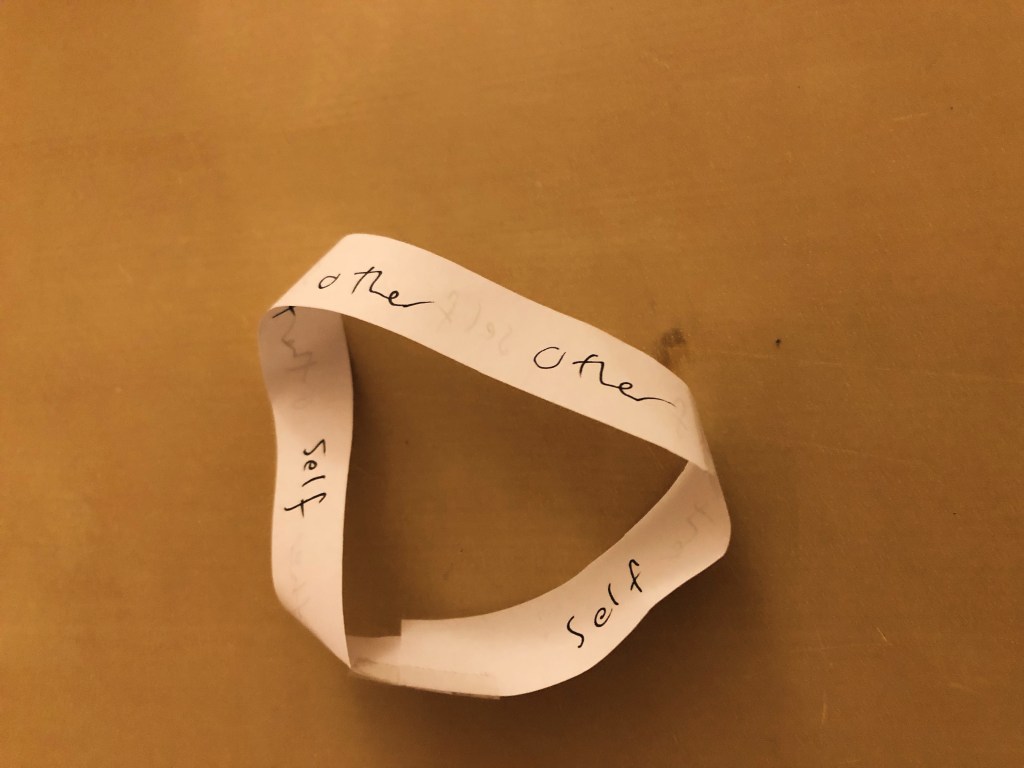
Image description: a loop of paper making a Möbius strip reads ‘self’ and ‘other’ on its different/same sides.
A learning community
Teaching on the modular LBMS training programs is to work as part of a learning community; something less common in other educational spaces, though often wished for. It helps to appreciate the many different parts that contribute to a whole learning context, through the different perspectives, roles and ways of engaging.
I had the advantage of leading a workshop for people who signed up for it, and with places limited, this already meant a sense of commitment. It meant participation was already active and engaged; the students wanted to be in the room. That helps a lot. But nevertheless, there is a vulnerability in learning and being seen, by both new people and people who’ve known you a while but in a different context. The whole experience required my trust of me to hold the space and to trust them to come with me. It required their trust in me, in each other, in themselves. None of this can be taken for granted, but is rather something to keep renegotiating. To move between sensing, thinking, feeling, and intuiting is as intensive as it is recuperative. Nevertheless, preferences will arise. The time taken over something will never be long enough for some people. There is always more to say, more things to have heard.
Crucial for this workshop was also the possibility of learning from and with one another. I was there to steer and support, to offer and hang back, to both keep time, and make time. Or, said another way, to Shape my way around the rough plan I had, and the tasks I wanted to share, or more specifically, try out. I had not taught this workshop before; it was created specifically for TQW. The fact I was in a room with people who didn’t know me, and many didn’t know each other, with different experiences of learning itself meant making a virtue out of the convergence of differences and experimentation. A space of meeting and creative encounter was the point.
In a group of mixed interests, skills, and experiences, at any one moment someone might be feeling more or less confident. And so there is the opportunity for people to show up for one another and bring their capacities to bear upon the situation in unexpected and shifting ways. Similarly, it means recognising in an immediate way that capacities can shift, as everyone has something to offer and take.

Image description: a portrait of Ali, upside down, taken in the mirrored ceiling of TQW.
Integration
There were many important and insightful experiences for the group and for me. I’ll share one before I conclude. Though I often changed task quite frequently, nevertheless some tasks required curation. One pair task that involves a lot of movement for one person requires quite a long time for something to happen. It was intended to produce the experience of exhausting movement ideas/responses, and to escape repetitive patterns. One person described her experience as reaching that plateau and then realising ‘f**k it, I can do whatever!’. I observed movement choices that had been using similar body level phrasing, a repeated use of Kinesphere, and often even phrasing in her dynamics for quite a long time (especially compared to other pairs in the room). Then I saw the moment of that realisation that released more variation in everything.
Developing more movement choice (not to say more intellectual range and conceptualisation) requires frames of challenge. Creative pedagogy embraces self-reflection as well as peer observation, through for example, facilitating movement scores for each other, moving in front of one another, conversing or group reading to accelerate such discoveries. I admire the Doing Things With Theory project as it aims to overcome some of the splits in education where theory or practice is favoured, rather than practiced together. I loved this invitation because it helped me integrate my research-analytical interests with my artistic-intuitive capabilities alongside my somatic movement education/LBMS tools. It meant I could experiment practically with my appreciation of space as multiple: a cellular phenomenon; a politics; Kinespheres singular and overlapping; the Space Harmony of a room, working.
It was around this time that a friend, currently researching performance, ritual and healing, asked me ‘and this what you’re doing, your workshops, where would you “place” them?’ I answered, ‘as creative pedagogy’. I see myself as an artist-facilitator, in which it is less about ‘making work for an audience’ and more about making spaces of creative exploration, and collective modes of learning/unlearning where the audiences are participants in the shared adventure of immersive creative and intellectual practice. Ivana also asked me if I see anything ritualistic in my work. Well, my work is not religious or particularly solemn. Nor is there a prescribed order of events, beyond the framing of starting and ending in ways that focus on a sense of a whole group (which translates to the classic example sitting or standing in a circle). If there is anything ritualistic, then it is appreciation for the group-gathering, the quality of heightened attention given to oneself and others, and an expectation of exploration and discovery. Creative pedagogy demands connecting to body (body/mind), the bodies of others and the social body, conceptualised as multiple.
Processing…
Success! You're on the list. Thank you.
Whoops! There was an error and we couldn't process your subscription. Please reload the page and try again.
 alexandrabaybutt.co.uk