About my book
Contemporary Dance Festivals in the Former Yugoslav Space: (in)dependent scenes was published with Routledge in 2023.
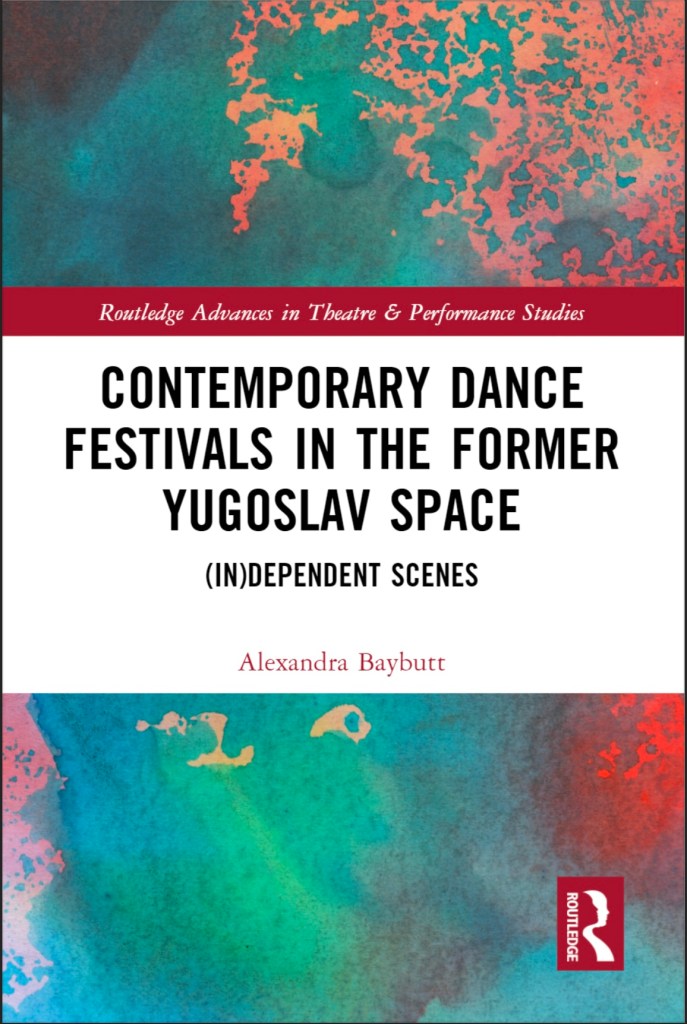
Contemporary Dance Festivals in the Former Yugoslav Space: (in)dependent scenes expands the understanding of conditions defining the creation and circulation of contemporary dance that differ across Europe. It focuses on festival-making connected with the Balkan regional project ‘Nomad Dance Academy’ (NDA) and highlights collective approaches to sustain a theorisation of festivals using the concepts of dissensus and imperceptible politics. Drawing from anthropological methods, three festivals PLESkavica, Slovenia; Kondenz, Serbia and LocoMotion, North Macedonia, are explored through social, political and historical currents affecting curatorial practice. This book closely follows how festival-makers navigate the values of international development that during and after the Yugoslav wars looked to art as part of peacekeeping and nation-building processes. This coincided with increasing discourse and practices of contemporary dance that gained momentum in the 1980s alongside European festivalisation. I show how contemporary dance acts as an agent for transformation, but also a carrier of older forms of social organisation, reflecting methods and values of Yugoslav Worker Self-management that are deployed by the groups creating the festivals.
Invitation
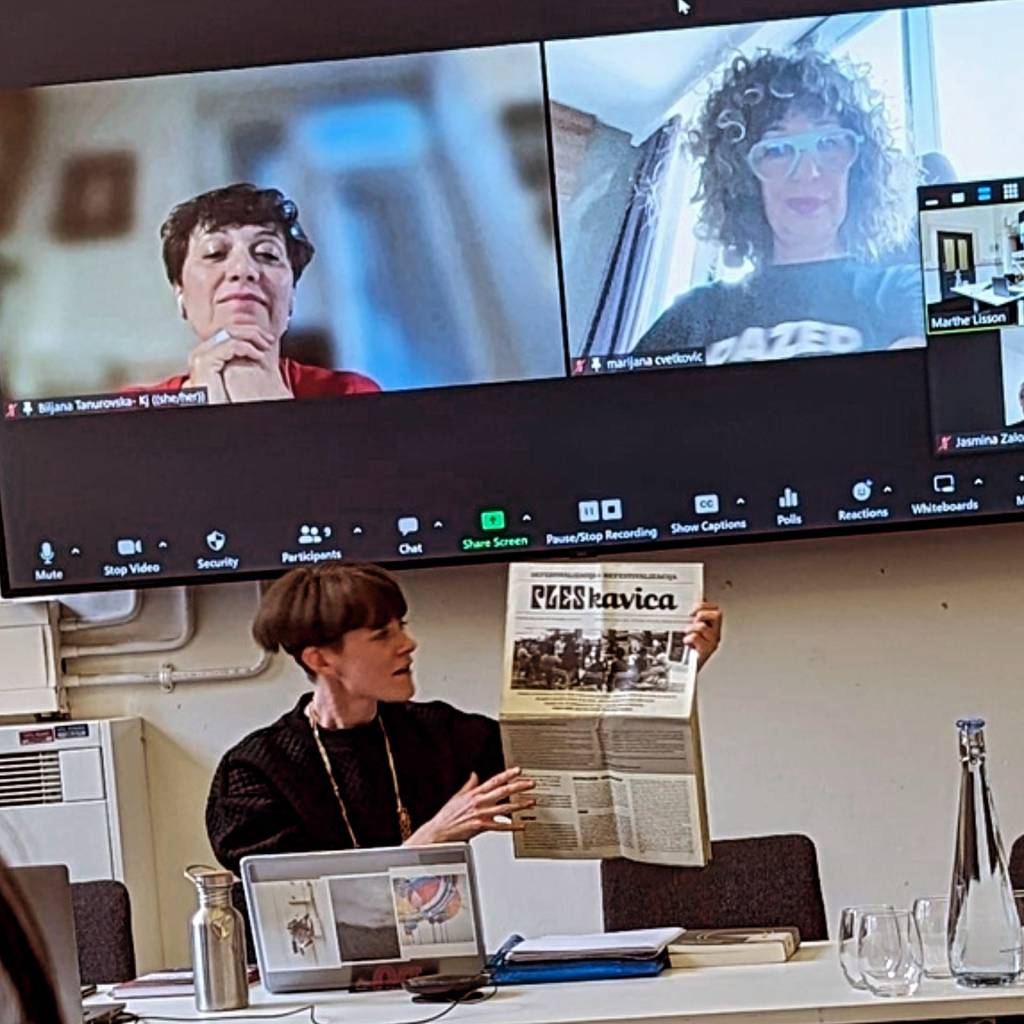
In celebration of my book I held a conversation on the 22 May 2024 with some of its key contributors: Marijana Cvetković, artistic director of Service Station for Contemporary Dance, Belgrade, Serbia; Jasmina Založnik, curator, scholar and co-producer Nomad Dance Slovenia/CoFestival, Ljubljana, Slovenia; and Biljana Tanurovska-Kjulavkovski, director of Lokomotiva, Skopje, North Macedonia. Joining in person were independent curators from the London dance and performance scene including Heidi Rustgaard and Hanna Gillgren (H2Dance / Fest En Fest), and Giuliana Majo (Trip Space).
In the spirit of the NDA principles (invitation, balance, and empty space), inviting these six guests who knew each other to varying degrees, demonstrated something of a balance between the context of my book (the former Yugoslav space) and a period of my research, and the context of where I live (London, UK). The conversation was intended to be open-ended, with no need to arrive at any particular conclusion or recommendations for festival-making or dance scholarship. Drawing upon the principle of empty space and improvisatory structures found in dance, I preferred to hold the occasion with the possibility for something to emerge. We used the book as a point of departure for a conversation across about working conditions for dance practices and the functions of festivals, thinking from and across our specific contexts.
This blog post shares some of the topics from conversations held with the guests before the book launch and during.
Why it mattered to create this event
It mattered to me to hold an event to celebrate and make visible the often unseen labour that goes into making festivals and the people who make them. Their role is often one of making space for artists and audiencess. I wanted to host them to connect between different festival events that I view as interconnected, and often sharing similar challenges and joys.
As part of dance scholarship, my work contributes to the historicisation of practices, composed of people and relations, and in which I am interwoven. It is through many events and spaces of encounter that knowledge and skills in dance practice and production are built, embodied in people through what they do and how they do it.
Lastly, it mattered to make the space to publicly thank those contributors from being in a position of having something to share. My 11-month post-doctoral fellowship at the IAS in 2021-22 created the conditions for me to develop the book. And now being part time at UCL, I have access to the IAS and could use some allocated and departmental research funding from UASc to offer my guests an honorarium for their time and contribution. I think it is important to make transparent the means of production underpinning how spaces of discourse in dance arise.
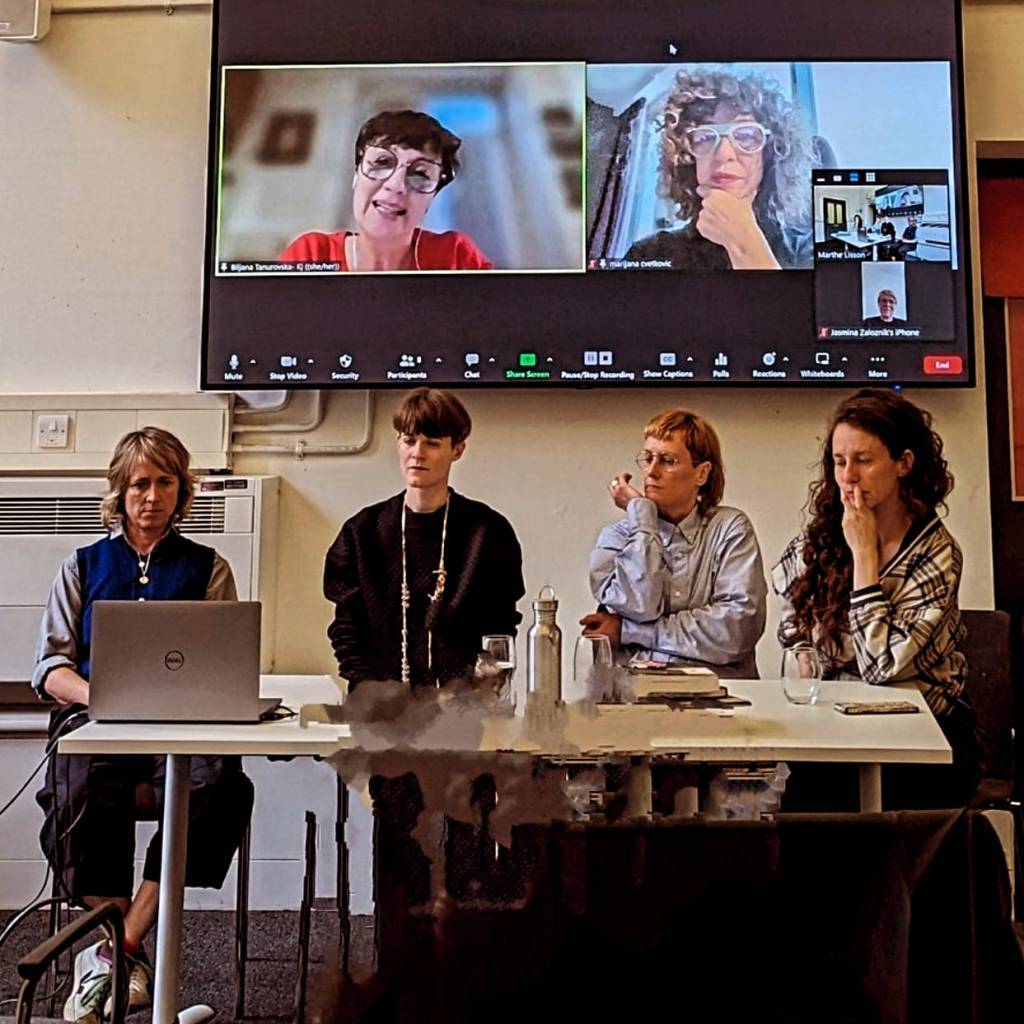
Top row: Biljana Tanurovska, Marijana Cvetković, Jasmina Založnik
Bottom row: Hanna Gillgren, Alexandra Baybutt, Heidi Rustgaard, Giuliana Majo.
Enduring topics in festival-making
My book emphasised examples of curatorial praxis in which festival-makers worked with their own theories and practices to present dance, choreography and performance under specific political and economic circumstances, for the various perceived needs of a context. Recurrent topics of concern for festival-makers or words that kept appearing became my preoccupations analytically or stood as heuristics or things to think with and through to consider what festival-making is and does. Topics and prevailing themes connect the scenes in London, Skopje, Ljubljana and Belgrade, though also show differences in how conditions have or haven’t changed in each city.
Conditions for dance practice here means creation, education, presentation and dissemination, all of which are contingent upon factors including and involving and not limited to: gentrification or privatisation affecting the availability, access and cost of suitable studios and performing spaces; funding structures and systems at borough/municipal, city and country level as well as the possibility of EU funds or other development networks; public funding arts policies that name time-based practices of dance and performance, and that support a space of experimentation in artistic practice; arrivals and departures in a city or country that diminish, contribute to or stabilise scenes and the people around to do, make, watch, write. For example, London is experiencing many people leaving because of pandemic, Brexit and the cost of living crisis over the past years, though still people come for education; for more than a decade Skopje has seen many young artists leave for opportunities elsewhere, and return is rare.
We discussed collaborative methods of festival-making and curation. This happens for a variety of reasons like practical necessity of there being insufficient funds to make it one person’s job. But it is also a practical advantage to redistribute seeing artistic works and sharing different perspectives in decision-making, in for example developing a curatorial theme. This opens the possibility of ongoing reflection and learning through being in dialogue with long-standing collaborators, something cherished my guests. Each sees the festival as a meeting place, and a space of celebration and learning.
I quoted Pia Brezavšček, cultural worker, Maska editor, writer and dramaturg from Nika Arhar’s edited collection: p. 102 – 103. Describing CoFestival, the festival that grew out of Pleskavica, the focus of chapter 4 of my book, Pia Brezavšček states that ‘this festival is a rare meeting point for artists and productions from the former Yugoslav space, mainly due to the strong regional network of Nomad Dance Academy […] some works by Serbian, Macedonian or Bulgarian artists resonate in my memory, which I would probably never have seen had they not been performed in Slovenia. This regional context is extremely important both for the self-understanding of the local scene and for broadening the horizons of those who only attend contemporary dance or are becoming professional audience members’. This quote from Pia Brezavšček echoes sentiments felt elsewhere about the function of a festival as a meeting point and an occasion of self-reflection and self-understanding of a scene.
We reflected upon the advantages and challenges of the ‘small’ festival, small in terms of duration and budget. The DIY element in cultural production presents a paradox of self-invitation in order to be able to do and show your work if opportunities are otherwise scarce. It can be a practical solution to exist parallel to institutions and their gate-keeping, hierarchies, and histories. But it was equally noted that to operate on DIY terms is of course unsustainable, leading to a certain amount of exhaustion and self-exploitation. An initial DIY, often experimental, moment can be the grounds on which to then apply for funds in order to continue, but it also makes a point to funders that if people are going to do it anyway, why does the public funding need to be there? These paradoxes of impulse and caution in DIY festivals and events in dance endure.
By thinking though artist-led projects, hosting and space-making, it was a chance for me to reflect on how I put the book together and what I left out methodologically. I was reminded that a thread in the book I didn’t pursue was viewing the curatorial through the choreographic. Fest En Fest as a festival of expanded choreography began as a response to a gap in the festivals in London. Much of the intellectual debates on dance and choreography are held in university contexts or in journals behind a pay-wall that are inaccessible if you do not have university affiliation. A festival rather than a university symposium offers a more public opportunity to attend to and engage in current debates, enjoy seeing work, and more often than not, people you might know or want to know.
My earlier MA research in 2007 about the London International Festival of London revealed to me how festivals appear to fill a gap. In LIFT’s case, it was an absence of international theatre in London in the 1980s. By the 2020s, Giuliana Majo observed how hyper local alliances matter as much as international guests in a circulation not simply of art works and artists, but of an understanding and appreciation of dance. I completed my PhD just as the pandemic began in 2020, which brough new questions for gathering that I did not approach in the book, such as online streaming and the hybrid event. Making hybrid more widespread normalised a new kind of access, and one I was happy to take up for the book event that enabled audiences and three guest speakers to be in the same frame. Through a slightly obsessive process collating the large database of festivals at the back of my book in order to argue how festivalisation in Europe implicated conditions for dance, I became interested in how festivals archive themselves for future audiences and how, like any performance work, they live beyond themselves. The PR, presenting and archiving of a festival however is not the festival. But what precisely is?
A question posed by an audience member at the book launch helped think this through. She asked: when does (the) dance begin? An answer from an expanded notion of choreography or a conception of social choreography situates the answer as in the time before and after a performance happens, as well as it. During this in-between time, or a phrase of preparation or anticipation followed by a phrase of reflection digestion, is the possibility of an encounter with one another. A frame of encounter within another frame insists upon bodily co-existence in all its sensory, affective complexity, keeping ‘dance’ multiple in definition and acknowledging how the curatorial shapes the experiences of audiences. A hybrid event can diminish the opportunity for relational, improvised in-between time, as the sociality of a digital interface requires an extra effort for affect. Nevertheless, I was glad audiences from Leeds, Belgrade and Austria could be ‘in’ London for a few hours.
Criticality and celebration
I raised the point that it becomes difficult to be critical of work I admire. The book event affirmed the contributions of TripSpace, Fest En Fest, Stanica, Lokomotiva and NDA Slovenia. The endurance (or ‘endurance as resistance’ – Biljana) of their directors to sustain was obvious. Their own self-reflexivity and processes of analysing their work already offered some insight into that work itself.
How do these specific cases open to some broader considerations of dance in the European space as a professional practice and how conditions contribute to meaningful working lives? As I was working on the book, the first case study about Locomotion festival addresses how and why it ended. I was ruminating on all the festivals and spaces that have closed, all the collectives that parted ways, all the people I trained and graduated with at dance school who are no longer ‘in dance’. In the plural job identities of people in and from ‘dance’ is a huge virtue as the insights gained from different perspectives enrich understanding, connections and methods of work. It’s beyond this blog post to open up questions of labour, learning, succession, project evaluation, obliqueness, key words of policy agendas and how the arts are valued, produced, instrumentalised, etc.
The NDA project models how neighbourliness amongst and between scenes is vital for the sustainability, differentiation and potential of the future of dance and choreography. Coexisting people and practices provide complementary contributions to different parts of a field or ecology of practices. As such, the curatorial continues to operate as a critical commentary upon the needs and interests of a scene. The festival acts a temporary lighthouse or island, making a new context in a context as a collectively held dramaturgy. How a context is navigating change in creative ways, obliquely ducking around problems, affirming something other than a prevailing status quo matters for better understanding instances of resistance through insistence and endurance.
A last comment on who is where
Whilst I am sceptical about reducing identity to narrow markers that might limit agency and becoming, I also must raise the point that all guests and audience at my book event were female or female-identifying. This point was in the background until near the end of the two hours when an audience member pointed it out and a question was posed about who occupies the power positions in dance practice and production in the respective countries. Gender and dance are not my research expertise, and this point opens future research questions that would build on the waves of dialogue around gender and dance that have been taking place in the UK for decades. How power is conceptualised though entanglements of gender, racism, classism, ageism, ableism and more would need instances of when power over/power to shift, for example when an artistic director of a festival or institution changes. I’d draw on Pierre Bourdieu’s concepts of cultural and social capital to try to make sense of how (self)invitation, long-term connections and professional relationships enable some paths through working life in dance.
Attempting to grasp the challenges to everyday life and working in/with dance and contemporary performance practices in the former Yugoslav space through the long-term consequences of the so-called ‘transition’ offers a map for any UK-based researcher attempting to understand the long-term consequences of Brexit (and the pandemic, and 14 years of a Conservative government) on conditions. What is lost, what is carried over, what is transformed? New questions of cultural production arise through turning to festivalisation and curatorial practices, such as hybridisation, access, para-institutional forms of education, and the EU networks’ dominance amidst the conditions for dance are all worthy of attention, and especially through the voices and perspectives of those who make these spaces.
My event was another instance in which gathering relies upon friendships, social networks and socialising to enable trust for possible future collaboration and cooperation in dance. But in thinking about power and modes of production in ecologies of dance practices, I’ll end with an invitation to thought and action from Tony Benn (1925 – 2014):
‘Ask the powerful five questions:
What power have you got? Where did you get it from? In whose interests do you exercise it? To whom are you accountable? How can we get rid of you?
Only democracy gives us that right. That is why no-one with power likes democracy and that is why every generation must struggle to win it and keep it; including you and me, here and now.’
Thanks to my guests, all audience, Jen for the photos, Marthe for the set-up and coordination, and the IAS/UCL for hosting.
 alexandrabaybutt.co.uk