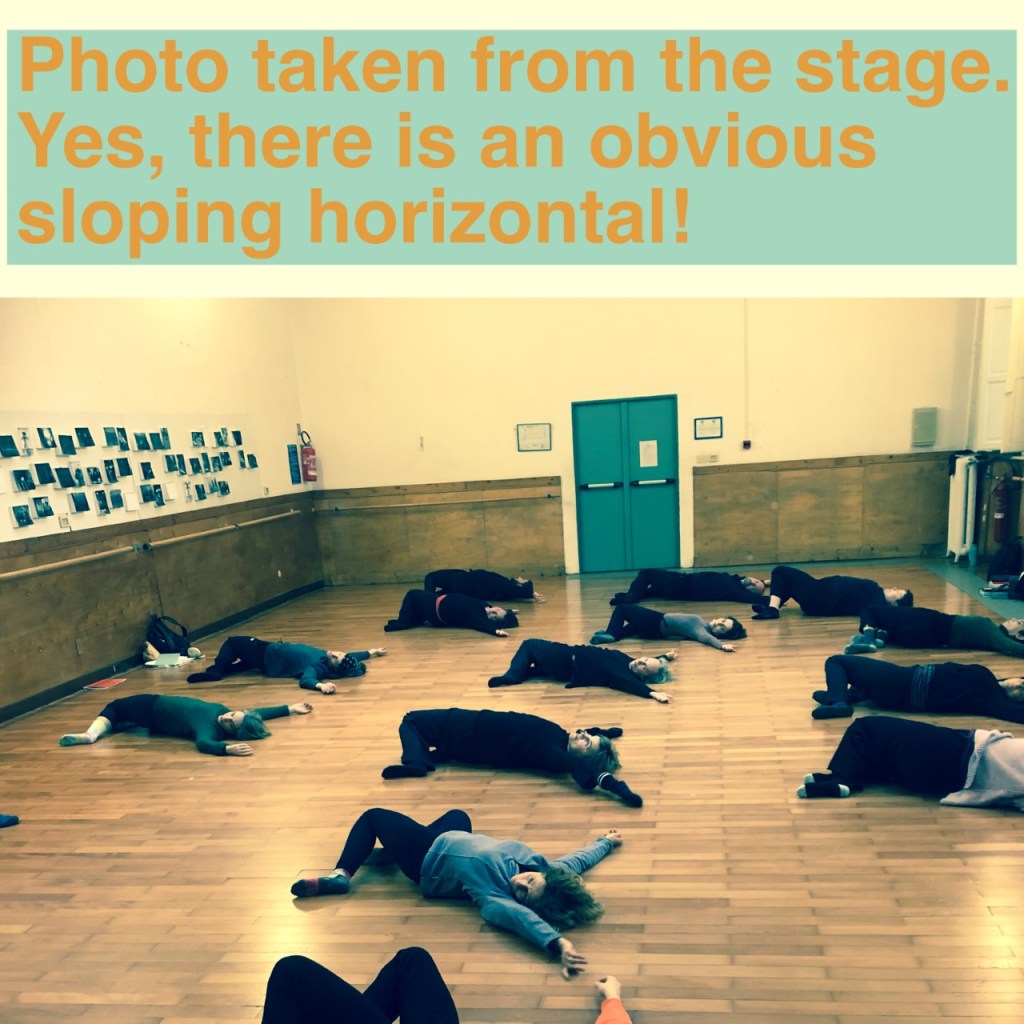
I am writing this in January, a typical month for setting goals and intentions, interrogating what’s important and what’s nonsense. I have recently been facilitating students in what a ‘personal practice’ might mean and it seemed like the right moment to share some thoughts here. I had a lot of fun working with BA students at the Rose Bruford drama school in London on the exceptionally interesting programme ‘European Theatre Arts’, and students on Module 2 of a WholeMovement programme in the Laban/Bartenieff Movement System in Rome (seen below exploring their Upper-Lower connection, directed by Karen Studd). This text arises in thanks to these groups, and out of my own experiences.
What is a personal movement practice?
- something regular
- something that can be for pleasure, health, recuperation, management, goals, work, play
- something that changes as you and your life changes
- something that you build into your life that makes sense for your schedule and demands
Why develop one?
- to check in with what your body is telling you it might need
- to check in with what your body is telling you it might want
- to feel present to yourself and connect to yourself in order to connect to others and your environment
- to trust your own playful instincts, connect to pleasure, be inspired by other things, practices, people
When is something not a personal movement practice?
- when it hurts
- when it is something you feel you ‘should’ do (unless a physiotherapist has given you some exercises for injury prevention or rehabilitation. Even then, these can become part of a practice that feels like it’s giving you more than only stronger muscles, useful as that is)
- when it’s boring
- when it’s no longer meaningful or serves its purpose
Story 1
A personal movement practice might happen with others or alone
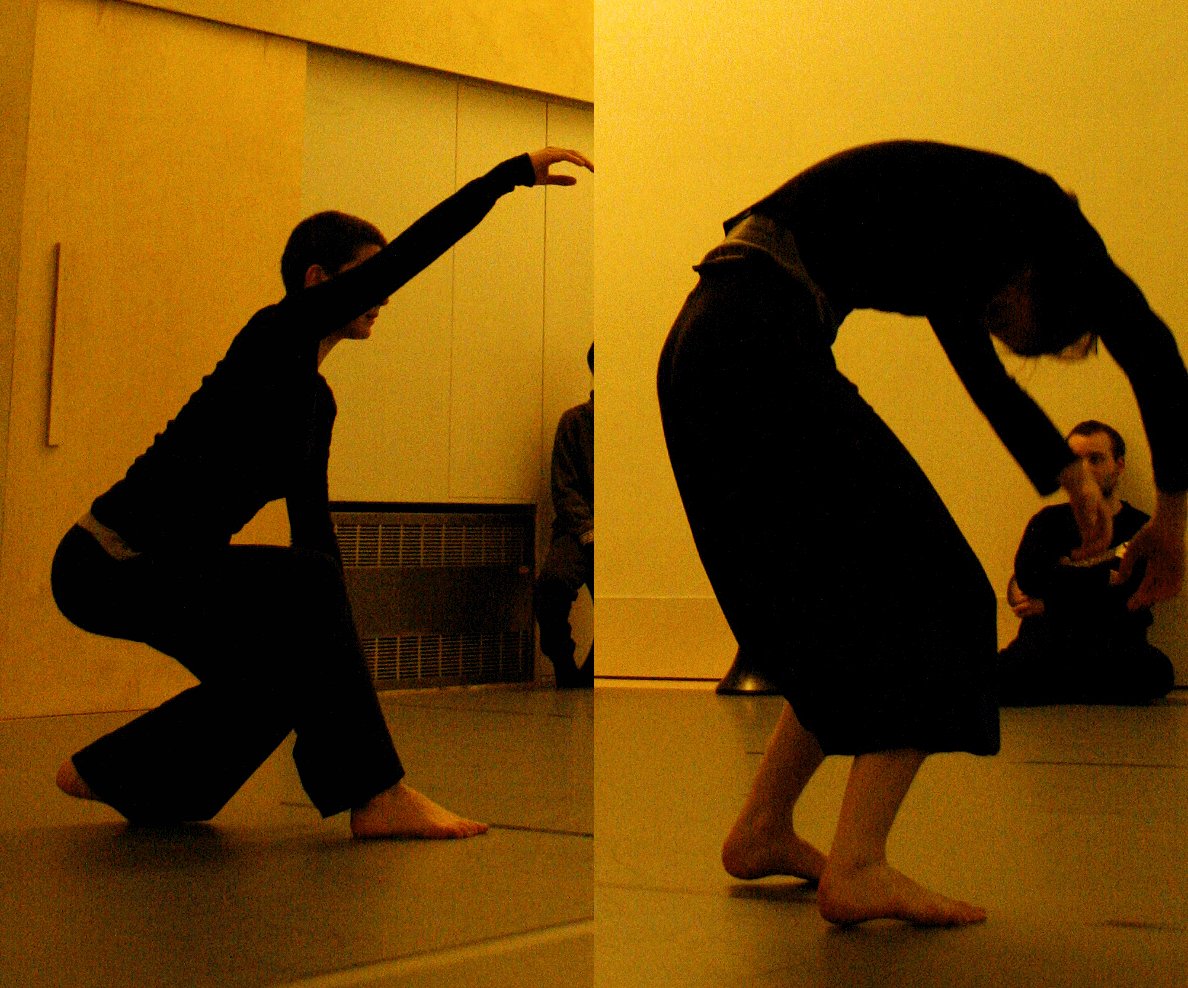
This is the artist Anais Bouts and I some time late 2005/early 2006 at the end of a residency at Clarence Mews space in London. We’d not long since graduated from Laban, and were exploring something to do with sound and improvisation. Anais’ is the one with the long spine, mine is the curve. Around this time I was having some Rolfing sessions that must have made my spine extra flexible because of the all fascia release.
A movement practice changes
A few months after this in 2006 I was in a car crash and relied upon the skills of my then-flatmate Hannah Wheeler who was studying Feldenkrais to gently bring me back to myself without the cracks of the osteopath I saw at the same time. Hannah offers public classes in person and online that I still go to when needing some of the deep quiet and precise autonomy of movement choice that Feldenkrais supports.
Story 2
Does it have to be indoors?

No!
Exit Map have for many years organised a ‘Shared Practice’ in south east London for dance artists, and those wanting a space for movement research that includes at times musicians and visual artists. We do our own thing separately and together. I am extremely grateful for the space and this space. I like going to classes, but I also like developing what I find myself or need to consider if I am teaching/facilitating something. In 2020 when we couldn’t meet indoors, Shared Practice became a Whatsapp group called ‘Openly Spaced Out’ where we would meet in parks to move together. This group is still active for regular and impromptu outdoor park dancing sessions. This picture is Exit Map founder Laura Doehler somewhere in a wood in France.
Concluding comments
An expanded approach to personal practice
Personal practices might connect to artistic and choreographic work, but don’t have to.
Some people’s personal practices relate to sport, prayer, play, processing. Some people’s includes increasing the amount of press-ups they can do. Or silent meditation then playing scales on their violin. Or making bread. Or rolling on the floor sensing the outlines of their bones.
The meaningfulness of a personal practice to life generally connects a person to understanding where in the phrase of their day, week, month or year. It helps to consider how and when something can be part of preparation or recuperation. And if you’re not sure what that means for you, see what happens if you move the question (or get in touch for a chat).
Some people’s personal practices look enviably beautiful / terrifying / minimal.
Be inspired, though recognise unique differences in approach, and don’t be afraid to try out something new.
It can be helpful to share with peers or a practitioner what it is you do, or want to do. A second opinion can be useful when it isn’t judgemental but is supportive of personal process and exploration. Somatic movement education concerns supporting people in learning how to learn, facilitating tools for self-trust and movement research to keep going with or without a teacher/practitioner around. Although as the joy of Exit Map’s Shared Practice shows, a community of peers to check in with and exchange tasks and explorations is a really supportive framework if you can build one or find one.
Do you have a personal practice but are not sure what could be changed/added/discarded? When something no longer serves its purpose: ask yourself:
- does this have too much or little structure
- is it too much related to a part of your body that could instead be considered part of the whole
- how does it feel when injury or illness appears
- is it pleasurable?
Feel like developing a personal practice? Not sure where to start? Follow the composer John Cage:
begin anywhere
Processing…
Success! You're on the list. Thank you.
Whoops! There was an error and we couldn't process your subscription. Please reload the page and try again.
 alexandrabaybutt.co.uk